

custodial vs non custodial wallets, custodial vs non custodial, custodial wallet vs non custodial wallet, hosted wallet vs non custodial
Custodial vs Non-Custodial Wallets
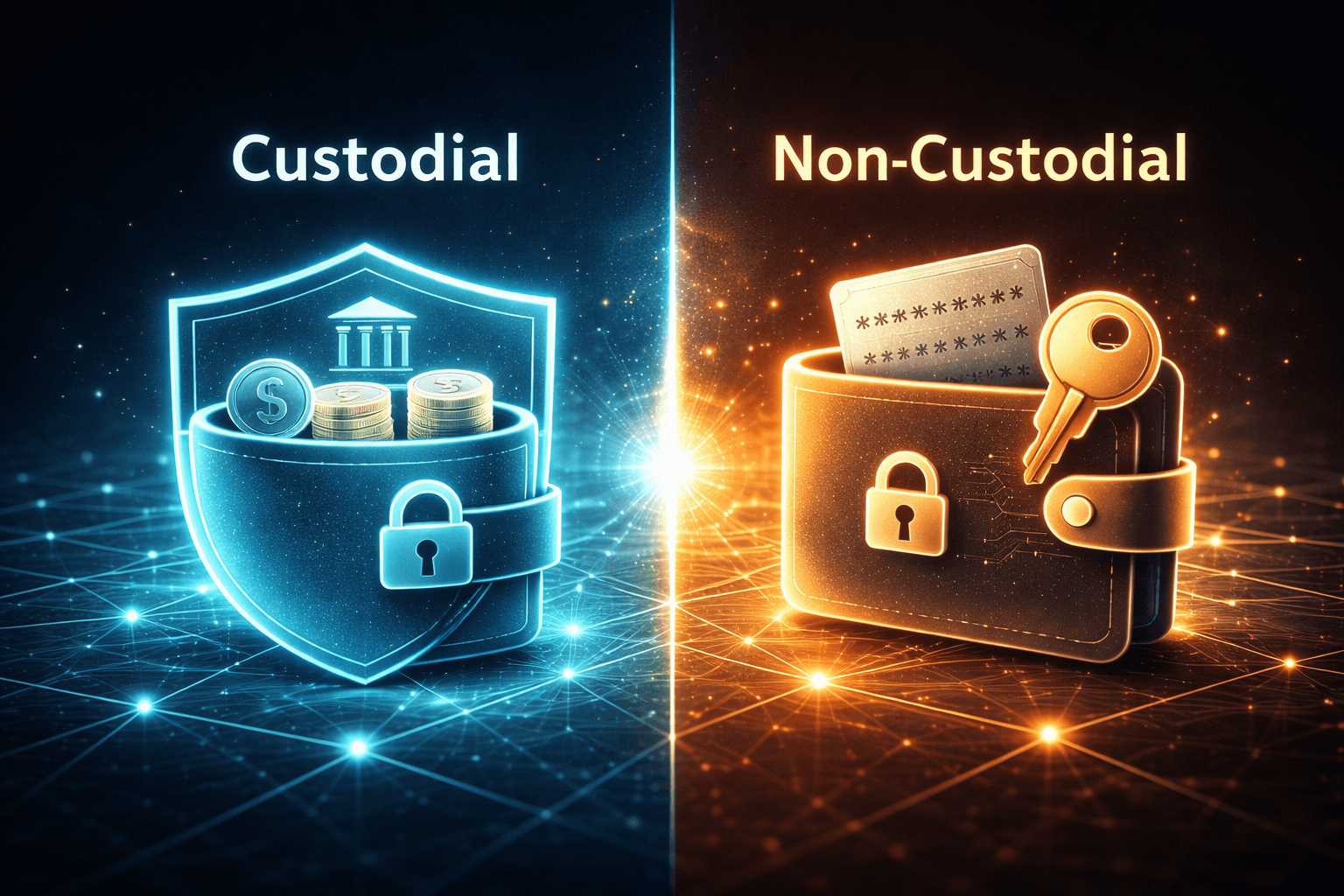
Custodial vs Non-Custodial Wallets: What’s the Difference?
One of the most important decisions in crypto isn’t which coin to buy. It’s how you store it. The choice between a custodial and non-custodial wallet determines who controls your private keys, how secure your assets are, and what risks you’re exposed to.
Understanding this distinction is critical for anyone using cryptocurrency, whether you’re a beginner buying your first tokens or an experienced user interacting with DeFi and Web3 apps.
What Are Custodial and Non-Custodial Wallets?
At a high level, the difference comes down to control.
Custodial wallets are wallets where a third party holds and manages your private keys on your behalf.
Non-custodial wallets are wallets where you control your private keys and therefore your crypto.
This distinction affects ownership, security, recovery options, and how you interact with the broader crypto ecosystem.
What Is a Custodial Wallet?
A custodial wallet is a crypto wallet managed by an exchange or service provider. When you use one, you don’t directly control your private keys. The provider does.
The important thing to understand is that custody is really about responsibility. Custodial wallets shift responsibility to a provider, while non-custodial wallets shift it to the user.
Most centralized exchanges offer custodial wallets by default.
How Custodial Wallets Work
With a custodial wallet:
You create an account with a provider
The provider generates and stores private keys
You access funds using a username, password, and sometimes 2FA
Transactions are authorized through the platform, not directly on-chain by you
From the user’s perspective, this feels similar to online banking.
Benefits of Custodial Wallets
Custodial wallets are popular because they prioritize convenience:
Easy onboarding for beginners
Password recovery and customer support
Integrated buying, selling, and trading
No need to manage private keys or recovery phrases
For new users, this simplicity can reduce early mistakes.
Limitations of Custodial Wallets
The trade-off for convenience is control:
You don’t own your private keys
Funds can be frozen or restricted
You’re exposed to platform hacks or failures
Withdrawals depend on the provider’s policies
This idea is often summarized as “not your keys, not your crypto.”
What Is a Non-Custodial Wallet?
A non-custodial wallet gives users full control over their private keys and crypto assets. No third party can access, freeze, or move funds without your approval.
These wallets are foundational to decentralization and Web3.
How Non-Custodial Wallets Work
With a non-custodial wallet:
Private keys are generated locally on your device
You receive a recovery (seed) phrase
Transactions are signed directly by you
Funds live on the blockchain, not with a provider
The wallet software acts as a tool, not a gatekeeper.
Benefits of Non-Custodial Wallets
Non-custodial wallets offer maximum autonomy:
Full ownership and control of crypto
Greater privacy
Permissionless access to DeFi, NFTs, and dApps
No reliance on a centralized company
For long-term holders and Web3 users, this control is a major advantage.
Limitations of Non-Custodial Wallets
With control comes responsibility:
You are fully responsible for security
Lost recovery phrases usually mean lost funds
No customer support for mistakes
Steeper learning curve for beginners
Mistakes in self-custody are often irreversible.
Custodial vs Non-Custodial Wallets: Key Differences
Private Key Ownership
Custodial: Provider controls private keys
Non-custodial: User controls private keys
This is the most important difference. Everything else flows from it.
Security and Risk
Custodial: Platform security matters most; users face counterparty risk
Non-custodial: User security habits matter most; no third-party risk
Neither is “perfectly safe,” but the risks are different.
Backup and Recovery Options
Custodial: Account recovery via email or support
Non-custodial: Recovery phrase is the only backup
Convenience vs sovereignty is the trade-off.
Ease of Use
Custodial: Very beginner-friendly
Non-custodial: Requires education and care
Custodial wallets reduce friction but limit independence.
Fees, Speed, and Control
Custodial: Fees and withdrawals may be controlled by the platform
Non-custodial: Users pay network fees directly and control timing
Self-custody offers more transparency and flexibility.
Access to DeFi and Web3 Apps
Custodial: Limited or indirect access
Non-custodial: Full access to DeFi, NFTs, DAOs, and dApps
Web3 participation generally requires non-custodial wallets.
Use Cases: Which Wallet Type Is Right for You?
When a Custodial Wallet Makes Sense
Custodial wallets may be appropriate if you:
Are new to crypto
Trade frequently on centralized exchanges
Want easy recovery options
Prefer simplicity over control
They can serve as a starting point.
When a Non-Custodial Wallet Is Better
Non-custodial wallets are better if you:
Hold crypto long-term
Use DeFi or Web3 apps
Value privacy and independence
Want full control over funds
They align closely with crypto’s original philosophy.
Can You Use Both Wallet Types Together?
Yes, and many users do.
A common strategy:
Custodial wallet for trading and fiat on-ramps
Non-custodial wallet for storage and Web3 use
This hybrid approach balances convenience and control.
Are Custodial and Non-Custodial Wallets Safe?
Both wallet types can be safe if used correctly.
Custodial wallets rely on the provider’s security practices
Non-custodial wallets rely on user behavior and key management
Most crypto losses happen due to:
Phishing
Poor key storage
Social engineering
Platform failures
Education and good habits matter more than wallet type alone.
Custodial vs Non-Custodial Wallet FAQs
What Is a Private Key?
A private key is a cryptographic secret that proves ownership of crypto and authorizes transactions. Anyone with the private key can control the funds.
Is a Non-Custodial Wallet Safer Than a Custodial Wallet?
It depends on the user.
Non-custodial wallets remove third-party risk but increase personal responsibility. Custodial wallets reduce user burden but introduce counterparty risk.
What Happens If a Custodial Wallet Provider Fails?
If a provider is hacked, insolvent, or shuts down, access to funds may be delayed or lost entirely, depending on how assets are held and regulated.
Can You Lose Crypto in a Non-Custodial Wallet?
Yes. Losing your recovery phrase, approving malicious transactions, or falling for scams can result in permanent loss. There is usually no way to recover funds.
Bottom Line: Custody Is About Control
The choice between custodial and non-custodial wallets comes down to who you trust: a third party, or yourself.
Custodial wallets prioritize convenience and ease of use
Non-custodial wallets prioritize ownership and independence
Understanding this distinction puts you in control of one of the most fundamental aspects of crypto: custody itself.




Get updates in your inbox
Get exclusive insights, actionable strategies, and ideas delivered straight to your inbox.